

Neutral Wire vs No Neutral Smart Switch: What Malaysian Homes Need to Know
If you are planning to install a smart switch in Malaysia, one of the first things you need to check is whether your switch point has a neutral wire. This is important because different smart switches are designed for different wiring situations.
Some smart switches need a neutral wire to work. Some no-neutral smart switches can work without a neutral wire, but they may require a capacitor. There are also 2-in-1 smart switches that can support both neutral and no-neutral wiring, depending on the installation.
In this guide, we explain the difference between neutral-wire and no-neutral smart switches, when a capacitor is needed, and how to choose the right type before buying.
This guide is especially useful if you are looking for a no neutral smart switch for Malaysian homes.
A no neutral smart switch can be useful for older homes, but it must be the correct model and may need a capacitor depending on the installation.
Quick Answer
A neutral-wire smart switch needs a neutral wire at the switch point. If your wall switch box does not have a neutral wire, you should choose a no-neutral smart switch or a 2-in-1 smart switch that supports no-neutral installation.
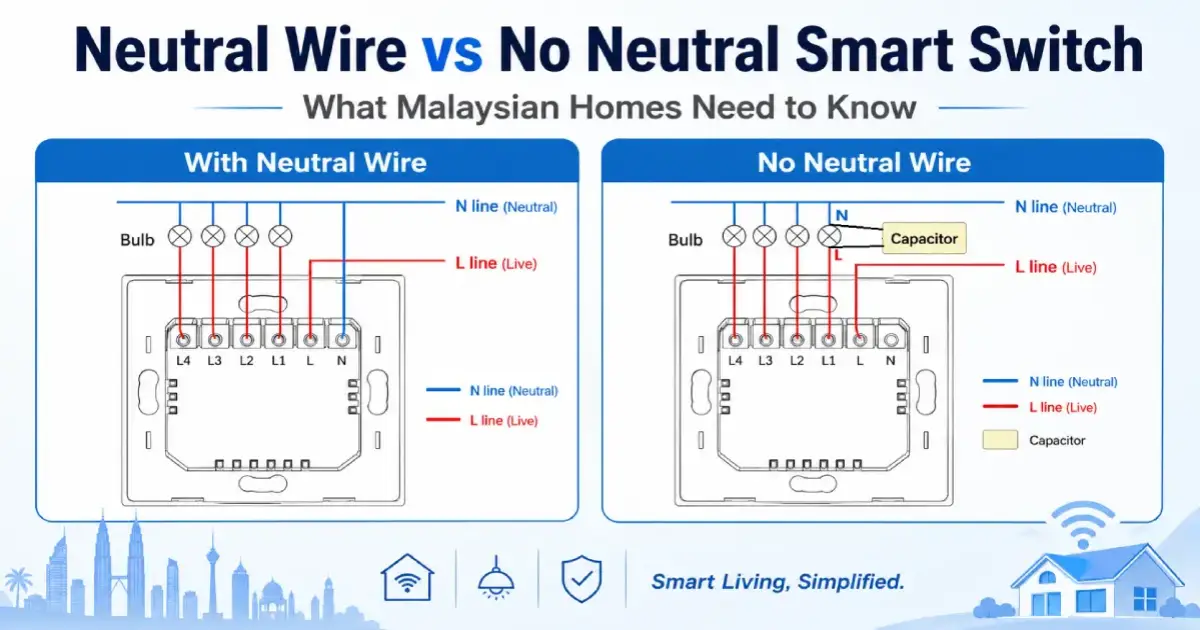
For no-neutral installation, a capacitor is usually required and should be installed at the first load, usually L1. If the switch is a pure neutral-wire version, a capacitor is not included and should not be used as a workaround.
What Is a Neutral Wire?
A neutral wire is part of the electrical circuit that allows power to return and complete the circuit. A normal conventional switch only opens or closes the live wire, so it does not need power for itself.
A smart switch is different. It has electronics inside, such as WiFi, Zigbee, relay, touch panel, indicator light, and sometimes Bluetooth pairing. Because of this, the smart switch itself needs power to stay online and respond to app control.
This is why many smart switches originally required a neutral wire.
Why Do Some Smart Switches Need Neutral Wire?
A neutral-wire smart switch gets stable power from the live and neutral wire. This usually gives better stability, especially for WiFi smart switches.
Neutral-wire smart switches are normally more suitable when:
- Your switch box already has a neutral wire
- You want a more stable installation
- You are controlling lights with low wattage
- You want to avoid using a capacitor
- You are doing new wiring or renovation
If your house is under renovation, it is usually a good idea to ask the electrician to prepare a neutral wire at the switch point. This gives you more flexibility for future smart home upgrades.
What Is a No-Neutral Smart Switch?
A no-neutral smart switch is designed for older wiring situations where the switch box only has live wire and load wire, without neutral.
To keep the smart switch powered, many no-neutral WiFi smart switches use a small amount of current through the load. Because of this, a capacitor may be required at the light side to help stabilize the circuit.
No-neutral smart switches are useful when:
- Your existing wall switch does not have a neutral wire
- You do not want to redo wiring
- You are upgrading from a normal switch to a smart switch
- You want app control without major renovation
However, no-neutral installation can be more sensitive to load type, low wattage lights, LED drivers, and wiring conditions.
What Is a renovation
A 2-in-1 smart switch is designed to support both situations:
- With neutral wire
- Without neutral wire
This makes it easier for customers who are unsure about their wiring. If you have a neutral wire, it can be installed with neutral. If you do not have a neutral wire, it can be installed as no-neutral, usually with a capacitor.
This type is often a safer choice before purchase because it gives more flexibility.
When Is a Capacitor Needed?
For no-neutral smart switch installation, the capacitor is usually installed at the first load, commonly L1. It helps provide stable power to the smart switch and reduces problems such as flickering, unstable operation, or the switch not staying online.
If the product is a 2-in-1 smart switch or a no-neutral smart switch, the capacitor is usually provided together with the switch.
If the product is a pure neutral-wire version, the capacitor is not included. Adding a capacitor to a pure neutral-wire switch will not convert it into a no-neutral switch and should not be used as a workaround.
Common Mistakes Before Buying
One common mistake is assuming every smart switch can work without neutral wire. This is not correct. Some smart switches are neutral-wire only.
Another common mistake is assuming that adding a capacitor can make any smart switch work without neutral. This is also not correct. The switch itself must be designed to support no-neutral installation.
Customers also sometimes forget to check the load type. Some lights, LED drivers, ceiling fans, fluorescent lights, or very low-wattage loads may not be suitable for all no-neutral smart switches.
Which Type Should You Choose?
If your switch box has neutral wire, a neutral-wire smart switch or 2-in-1 smart switch is usually recommended.
If your switch box does not have neutral wire, choose a no-neutral smart switch or a 2-in-1 smart switch that clearly supports no-neutral installation.
If you are not sure whether your switch box has neutral wire, choose a 2-in-1 smart switch, or ask an electrician to check before purchasing.
For renovation or new wiring, we recommend preparing neutral wire at the switch point whenever possible.
Can I Install It Myself?
Smart switch installation involves electrical wiring. If you are not familiar with electrical work, it is better to ask a qualified electrician to install it.
Incorrect wiring may cause the switch not to work, the light to flicker, the switch to go offline, or in some cases, create electrical safety risks.
Before installation, always check:
- Whether the switch requires neutral wire
- Whether the switch supports no-neutral installation
- Where the capacitor should be installed
- Whether the load is suitable
- Whether the total load is within the switch rating
Related FAQ and Products
If you are still unsure which smart switch is suitable for your wiring, these FAQ articles may help:
- Does the smart switch include a capacitor?
- Why do I need to consider whether a neutral wire is available?
- Where should the capacitor be installed?
- Can I install a smart switch without a neutral wire?
You can also browse our smart switch products here:
Final Recommendation
Before buying a smart switch, always check whether your current wall switch has a neutral wire. This will help you choose the correct product and avoid installation problems.
For most Malaysian homes, a 2-in-1 smart switch is a flexible choice because it can support both neutral and no-neutral wiring situations, depending on the installation.
Still unsure which smart switch is suitable for your wiring? Contact us before purchasing, and we can help you choose the right type.